
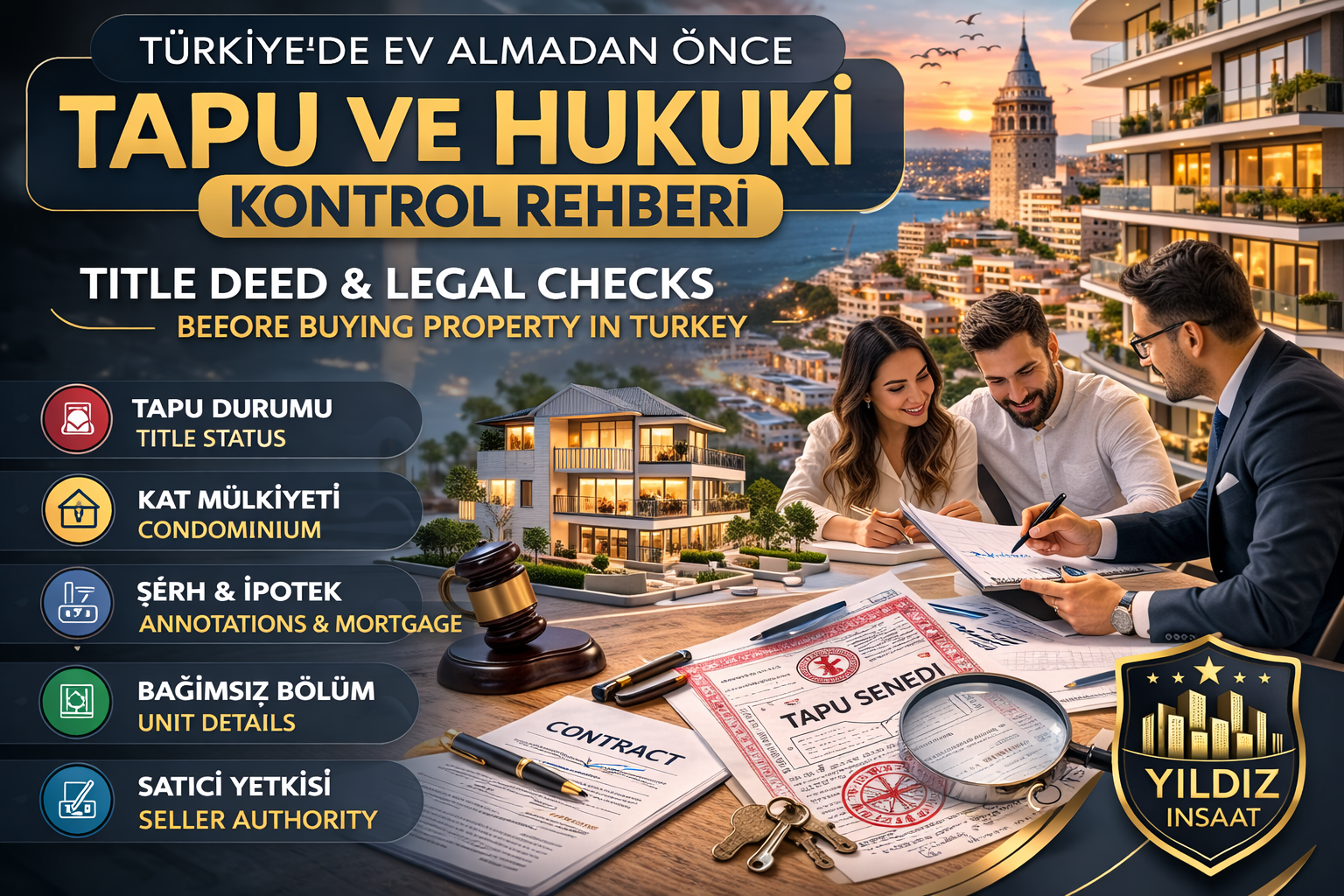
Title Deed and Legal Checks Before Buying Property in Turkey
2026-03-09
Before buying property in Turkey, it is important to look beyond price and location. Title deed status, unit details, condominium status, annotations, mortgages, and other legal checks can directly affect the safety of the transaction. This guide explains the key title deed and legal points buyers should review before making a purchase.
When buying a home in Turkey, many buyers naturally focus first on price, location, and the appearance of the property. However, one of the most important parts of the process is understanding the title deed status and the legal structure behind the sale. A property may look fully suitable in person and still raise important issues in the official record. For that reason, a buying decision should never rely only on listing descriptions, verbal statements, or the visual condition of the apartment. A safer decision comes from reviewing the official status of the property as carefully as its physical features.
Why is the title deed so important? Because the title deed record is one of the main official references that shows how the property is registered. Buyers need to understand who is recorded as the owner, how the independent unit is identified, and whether the property being shown matches the property described in the official record. From a practical point of view, the goal is simple: the apartment being sold should clearly match the apartment registered. That is why seeing the home in person is not enough on its own. The formal record also needs to be reviewed carefully.
Why does the difference between condominium ownership and construction servitude matter? In Turkey, buyers often come across the terms kat mülkiyeti and kat irtifakı. Official land-registry materials describe kat irtifakı as a right established for independent sections on land where a structure is being built or is planned, while kat mülkiyeti refers to the condominium ownership structure of independent units in a more settled form. For a buyer, the key point is not memorizing technical language, but understanding what the property’s recorded status actually means and whether the documentation is clear and consistent.
Why should the independent unit details be checked carefully? Because the apartment visited by the buyer should match the independent unit described in the official record. Block number, floor, unit number, and the legal identity of the section matter more than many buyers first assume. Some buyers become comfortable after seeing the home and forget to verify these technical details. But if the officially recorded section and the physically shown section do not fully match, the risk can be significant. A safe transaction depends on clarity between the real-world property and the registered property.
Why do annotations, mortgages, and similar records matter? Because entries attached to the property record can affect the transaction, the use of the property, or the buyer’s future security. Many people assume that having a title deed is enough, but what matters just as much is what appears in the record itself. Mortgages, liens, injunctions, annotations, or other legal notes may change the meaning of the purchase entirely. A home may appear attractive in every practical way and still require caution because of its official record. This is one of the areas where careful professional review is especially important.
Why does the seller’s authority need to be confirmed? The person handling the sale should either be the legal owner or be clearly authorized to act. This becomes even more important when the transaction is being carried out through a representative or power of attorney. One of the easiest mistakes buyers make is assuming that the person presenting the property automatically has full authority to complete the sale. From a legal-safety perspective, the buyer should understand who is acting, in what capacity, and with what authority.
Is seeing the title deed alone enough? Usually not. A safer buying process does not depend on one document only. Municipal records, project alignment, occupancy-related issues, building records, and other official elements may also matter depending on the property. The title deed record is central, but it may not answer every practical and legal question by itself. Especially in higher-value transactions, documents are better reviewed together rather than in isolation.
Why do occupancy and actual use matter? Many buyers pay attention only to the interior condition of the apartment, but the relationship between actual use and official structure can also be important. It is worth checking whether the current use of the unit is consistent with the documented structure, whether common areas are being used properly, and whether the wider legal framework of the building appears orderly. From the buyer’s perspective, the basic goal is to avoid a mismatch between the living space they see and the official structure behind it. Greater consistency usually means greater safety.
Why should foreign buyers review the process even more carefully? Turkey’s official investment guidance explains that real-estate acquisition by foreign buyers is processed through the Land Registry and Cadastre system and that additional rules or evaluations may apply depending on the buyer’s status and the property’s location. For that reason, foreign buyers should not stop at the standard document check. It is wise to confirm the current official framework separately before moving too far into the transaction.
Why should verbal assurances be treated carefully? During property sales, buyers often hear statements such as “everything is clear,” “the papers are ready,” or “there is no issue in the title.” But property purchases should not rely on verbal comfort alone. The safer approach is always to confirm key points through official records and professional review. A legal issue discovered after purchase may sometimes be the kind of issue that could have been identified much earlier through routine checks.
Why is the deposit or pre-agreement stage sensitive? Many buyers feel pressure to move quickly so they do not lose the property. However, paying a deposit or signing documents before the legal framework is reasonably clear can create avoidable risk. Before any payment is made, the buyer should try to confirm the property’s legal structure, the seller’s authority, and the core document picture as much as possible. When time pressure leads to skipped checks, the risk usually rises.
Why does professional support matter? Because property purchases involve both significant money and legal consequences. It is not always easy for a buyer to identify every risk alone. Title records, document consistency, authority issues, and transaction details can often be assessed more objectively with professional guidance. This is not about making the process unnecessarily complicated. It is about reducing the chance of facing a much larger problem later.
What is one of the most common mistakes buyers make? A frequent mistake is treating legal review as a formality after emotionally deciding on the property. In reality, the opposite approach is safer. A home can be attractive, well located, and within budget, yet still require serious legal caution. The official record, the seller’s authority, and the clarity of the transaction matter just as much as the property itself. Buyers often become attached to the home first and review the paperwork second. That is exactly what creates avoidable disappointment.
How can the process be made safer? The best approach is to clarify the legal basics early. Buyers should ask who the seller is, whether the selling authority is clear, whether the independent unit details match the apartment shown, whether the record contains entries that may create risk, and whether the actual use of the property is broadly consistent with the official structure. After that, the process can be supported with legal and technical review when needed. This leads to a decision based on verified information rather than momentum or assumption.
Conclusion Before buying a home in Turkey, title deed and legal review should be treated as a core part of the decision, not a final formality. Checking the title deed record, understanding whether the property is under kat mülkiyeti or kat irtifakı, confirming the independent unit details, reviewing annotations or mortgages, and clarifying the seller’s authority are all basic steps toward a safer transaction. The right home is not only the one that looks appealing. It is the one with a clear official record, an understandable legal structure, and a transaction process that stands on solid ground.
Frequently Asked Questions
Is seeing the title deed enough on its own? No. The content of the record, the legal status of the property, and supporting documents should be reviewed together.
Does the difference between kat mülkiyeti and kat irtifakı matter? Yes. The status in the record helps explain the legal structure of the property and should be clearly understood before purchase.
If there is a mortgage or annotation, does that automatically end the deal? Not automatically, but it does require careful professional review before any decision is made.
What should be checked before paying a deposit? The seller’s authority, the title deed status, the independent unit details, and the basic legal picture should be clarified as much as possible.
Can the process be different for foreign buyers? Yes. Additional rules or official steps may apply, so the current official framework should be checked separately.
Why is the title deed so important? Because the title deed record is one of the main official references that shows how the property is registered. Buyers need to understand who is recorded as the owner, how the independent unit is identified, and whether the property being shown matches the property described in the official record. From a practical point of view, the goal is simple: the apartment being sold should clearly match the apartment registered. That is why seeing the home in person is not enough on its own. The formal record also needs to be reviewed carefully.
Why does the difference between condominium ownership and construction servitude matter? In Turkey, buyers often come across the terms kat mülkiyeti and kat irtifakı. Official land-registry materials describe kat irtifakı as a right established for independent sections on land where a structure is being built or is planned, while kat mülkiyeti refers to the condominium ownership structure of independent units in a more settled form. For a buyer, the key point is not memorizing technical language, but understanding what the property’s recorded status actually means and whether the documentation is clear and consistent.
Why should the independent unit details be checked carefully? Because the apartment visited by the buyer should match the independent unit described in the official record. Block number, floor, unit number, and the legal identity of the section matter more than many buyers first assume. Some buyers become comfortable after seeing the home and forget to verify these technical details. But if the officially recorded section and the physically shown section do not fully match, the risk can be significant. A safe transaction depends on clarity between the real-world property and the registered property.
Why do annotations, mortgages, and similar records matter? Because entries attached to the property record can affect the transaction, the use of the property, or the buyer’s future security. Many people assume that having a title deed is enough, but what matters just as much is what appears in the record itself. Mortgages, liens, injunctions, annotations, or other legal notes may change the meaning of the purchase entirely. A home may appear attractive in every practical way and still require caution because of its official record. This is one of the areas where careful professional review is especially important.
Why does the seller’s authority need to be confirmed? The person handling the sale should either be the legal owner or be clearly authorized to act. This becomes even more important when the transaction is being carried out through a representative or power of attorney. One of the easiest mistakes buyers make is assuming that the person presenting the property automatically has full authority to complete the sale. From a legal-safety perspective, the buyer should understand who is acting, in what capacity, and with what authority.
Is seeing the title deed alone enough? Usually not. A safer buying process does not depend on one document only. Municipal records, project alignment, occupancy-related issues, building records, and other official elements may also matter depending on the property. The title deed record is central, but it may not answer every practical and legal question by itself. Especially in higher-value transactions, documents are better reviewed together rather than in isolation.
Why do occupancy and actual use matter? Many buyers pay attention only to the interior condition of the apartment, but the relationship between actual use and official structure can also be important. It is worth checking whether the current use of the unit is consistent with the documented structure, whether common areas are being used properly, and whether the wider legal framework of the building appears orderly. From the buyer’s perspective, the basic goal is to avoid a mismatch between the living space they see and the official structure behind it. Greater consistency usually means greater safety.
Why should foreign buyers review the process even more carefully? Turkey’s official investment guidance explains that real-estate acquisition by foreign buyers is processed through the Land Registry and Cadastre system and that additional rules or evaluations may apply depending on the buyer’s status and the property’s location. For that reason, foreign buyers should not stop at the standard document check. It is wise to confirm the current official framework separately before moving too far into the transaction.
Why should verbal assurances be treated carefully? During property sales, buyers often hear statements such as “everything is clear,” “the papers are ready,” or “there is no issue in the title.” But property purchases should not rely on verbal comfort alone. The safer approach is always to confirm key points through official records and professional review. A legal issue discovered after purchase may sometimes be the kind of issue that could have been identified much earlier through routine checks.
Why is the deposit or pre-agreement stage sensitive? Many buyers feel pressure to move quickly so they do not lose the property. However, paying a deposit or signing documents before the legal framework is reasonably clear can create avoidable risk. Before any payment is made, the buyer should try to confirm the property’s legal structure, the seller’s authority, and the core document picture as much as possible. When time pressure leads to skipped checks, the risk usually rises.
Why does professional support matter? Because property purchases involve both significant money and legal consequences. It is not always easy for a buyer to identify every risk alone. Title records, document consistency, authority issues, and transaction details can often be assessed more objectively with professional guidance. This is not about making the process unnecessarily complicated. It is about reducing the chance of facing a much larger problem later.
What is one of the most common mistakes buyers make? A frequent mistake is treating legal review as a formality after emotionally deciding on the property. In reality, the opposite approach is safer. A home can be attractive, well located, and within budget, yet still require serious legal caution. The official record, the seller’s authority, and the clarity of the transaction matter just as much as the property itself. Buyers often become attached to the home first and review the paperwork second. That is exactly what creates avoidable disappointment.
How can the process be made safer? The best approach is to clarify the legal basics early. Buyers should ask who the seller is, whether the selling authority is clear, whether the independent unit details match the apartment shown, whether the record contains entries that may create risk, and whether the actual use of the property is broadly consistent with the official structure. After that, the process can be supported with legal and technical review when needed. This leads to a decision based on verified information rather than momentum or assumption.
Conclusion Before buying a home in Turkey, title deed and legal review should be treated as a core part of the decision, not a final formality. Checking the title deed record, understanding whether the property is under kat mülkiyeti or kat irtifakı, confirming the independent unit details, reviewing annotations or mortgages, and clarifying the seller’s authority are all basic steps toward a safer transaction. The right home is not only the one that looks appealing. It is the one with a clear official record, an understandable legal structure, and a transaction process that stands on solid ground.
Frequently Asked Questions
Is seeing the title deed enough on its own? No. The content of the record, the legal status of the property, and supporting documents should be reviewed together.
Does the difference between kat mülkiyeti and kat irtifakı matter? Yes. The status in the record helps explain the legal structure of the property and should be clearly understood before purchase.
If there is a mortgage or annotation, does that automatically end the deal? Not automatically, but it does require careful professional review before any decision is made.
What should be checked before paying a deposit? The seller’s authority, the title deed status, the independent unit details, and the basic legal picture should be clarified as much as possible.
Can the process be different for foreign buyers? Yes. Additional rules or official steps may apply, so the current official framework should be checked separately.