
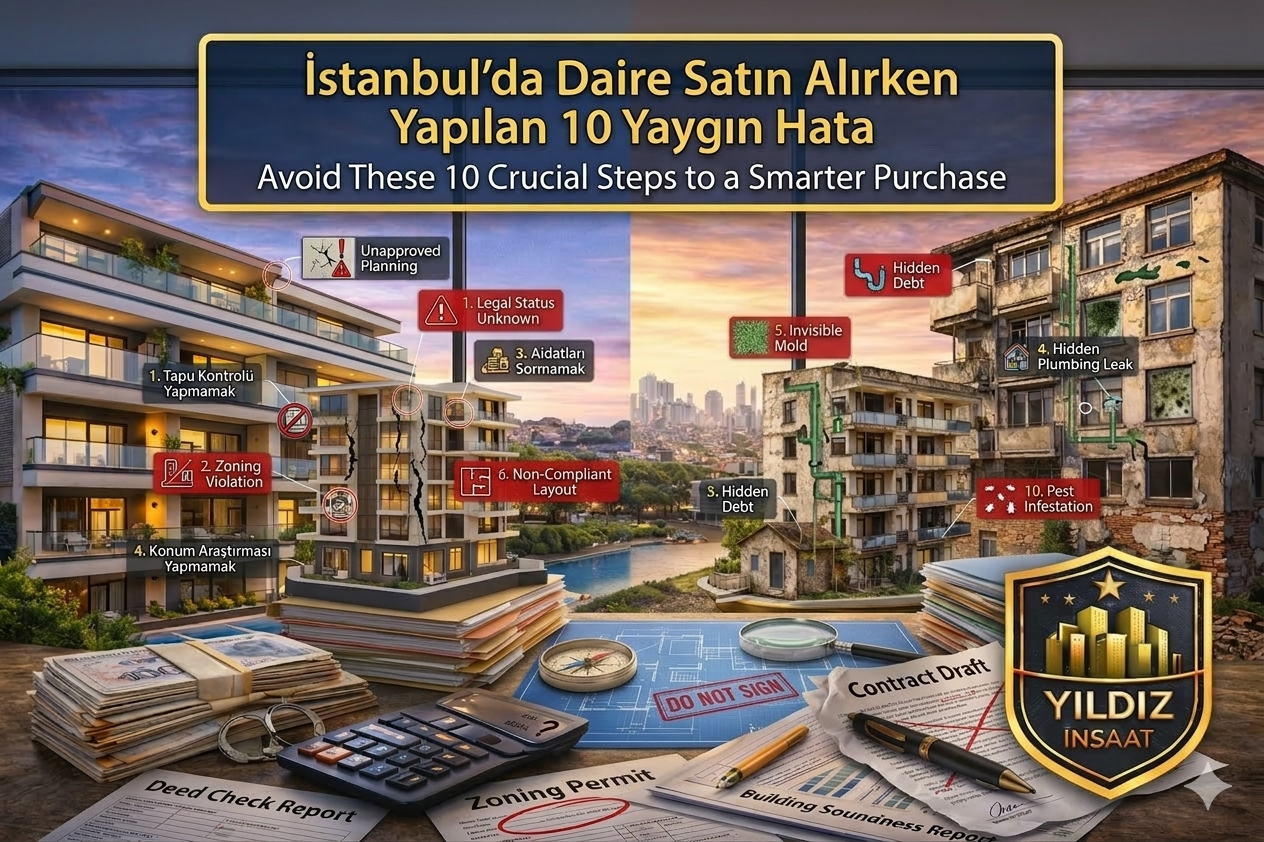
10 Common Mistakes When Buying an Apartment in Istanbul
2026-03-08
Buying an apartment in Istanbul can be exciting, but common mistakes can lead to unnecessary costs, poor decisions, and long-term regret. This article explains 10 frequent mistakes buyers make and highlights the key points to consider before making a purchase.
Buying an apartment in Istanbul can be exciting, but it also requires careful judgment. Many buyers focus on price, appearance, or the fear of missing a good opportunity, and this often leads to decisions they later regret. In a city as large and varied as Istanbul, even apartments with similar prices can differ greatly in daily comfort, long-term cost, location quality, and resale potential. For this reason, the most common mistakes usually happen when buyers move too quickly, compare too little, or pay attention to the wrong details. A better purchase decision comes from looking at the apartment as a whole rather than reacting to a single attractive feature.
One of the most common mistakes is trusting the listing too much. Property listings are designed to present the apartment in the best possible way. Wide-angle photography, bright editing, carefully chosen descriptions, and selective details can make a home look more spacious, cleaner, and more practical than it really is. However, important factors such as natural light, street noise, building condition, moisture, and real layout quality can only be understood properly during an in-person visit. A good listing can help create interest, but it should never replace direct evaluation.
Another common mistake is calculating the budget only around the purchase price. Many buyers look at the listing amount and assume that this is the real financial picture. In reality, the total cost of buying can be much higher once additional expenses are considered. These may include purchase-related fees, document costs, possible renovations, moving expenses, furniture updates, building fees, and ongoing monthly costs. An apartment that looks affordable at first may become much heavier on the budget once these practical expenses are added. That is why the smarter comparison is not based only on sale price, but on total ownership cost.
A third mistake is judging the location only from the map or district name. In Istanbul, a location that sounds strong on paper may feel very different in daily life. A short walking distance to transport may still involve a steep hill, traffic-heavy roads, or an inconvenient route. Some streets feel well connected, while others feel isolated even though they are technically in the same neighborhood. Parking pressure, daily crowd levels, street activity, and access to basic services all affect how practical a location really is. Buyers should evaluate the exact surroundings of the apartment, not just the broader district.
Another frequent mistake is not paying enough attention to the apartment’s actual layout. A property may seem attractive because of its square meter figure, but daily comfort depends on how that space is used. Long corridors, awkward room shapes, limited storage, or difficult furniture placement can reduce real usability. In some homes, the living room may look large while the bedrooms feel too small. In others, the kitchen may technically exist but still be uncomfortable for daily use. Buyers often regret focusing on numbers rather than function. A practical layout usually matters more than a large but inefficient plan.
Many buyers also make the mistake of overlooking the building itself. Even if the apartment interior has been renovated or staged well, the building may reveal future problems. The entrance, staircase, elevator, facade, roof-related condition, and common areas all provide clues about maintenance quality and management standards. A neglected building may lead to future repair expenses, shared-area disputes, or lower long-term satisfaction. Since an apartment cannot be separated from the building it belongs to, the overall structure should always be evaluated along with the unit itself.
Ignoring monthly building fees is another mistake that can create problems later. Some buyers focus so heavily on the purchase decision that they treat ongoing building costs as secondary. In reality, monthly fees can have a major effect on affordability. This is especially true in buildings with elevators, security, parking, landscaping, or social facilities. A home with a manageable purchase price may still become difficult to maintain if monthly costs are high. Buyers should always ask what the monthly fee includes, whether it has changed recently, and whether the building is likely to require additional shared expenses.
A further mistake is failing to consider the lifestyle of the building and the surrounding environment. An apartment is not only a physical space; it is also part of a daily living system. Noise levels, neighbor profile, shared-space cleanliness, short-term movement in the building, and the general sense of order all influence long-term satisfaction. A property may look excellent inside while the wider living environment feels unstable, loud, or poorly maintained. Especially for families, remote workers, older residents, or buyers who want a calm routine, this factor can be just as important as the apartment itself.
Another common error is leaving legal clarity until very late in the process. A full legal review naturally comes closer to the final stages, but that does not mean all basic questions should be postponed. Buyers should seek early clarity on the title deed situation, whether the property being shown matches the unit being offered, whether there are known document issues, and whether anything may delay the transaction. Waiting too long to ask basic questions can waste time, create false expectations, and increase the risk of emotional attachment to a property that later proves problematic.
Many buyers also confuse personal-use buying with investment buying. At first, both may seem similar because the same apartment can appear suitable for either purpose. In practice, they often require different priorities. A property that feels comfortable for personal living may not be the strongest rental asset. On the other hand, an apartment with strong rental appeal may not fit a family’s daily lifestyle. When buyers do not decide clearly whether they are buying for their own use, for rental income, or for long-term value preservation, they often compare properties using the wrong criteria. A better purchase process begins by defining the purpose first.
Another major mistake is making a rushed decision without enough comparison. Istanbul’s property market can feel fast-moving, and this creates pressure. Buyers sometimes believe that if they do not act immediately, they will lose the opportunity. While speed can sometimes be important, rushed decisions often lead to weak comparison and incomplete evaluation. Seeing multiple properties in the same budget range, comparing layout quality, checking building condition, and understanding the real location differences usually produces a much better outcome. Fast decisions can be necessary, but uninformed decisions are rarely wise.
Why do these mistakes happen so often? One reason is that buying a home is both a financial and emotional decision. Buyers may imagine their future life in the property before fully understanding its weaknesses. A fresh interior, a strong first impression, or pressure from the sales process can make people ignore practical concerns. In addition, the amount of information involved in a purchase can be tiring. Price, location, condition, documents, fees, and long-term plans all have to be considered at once. Without a structured approach, it becomes easy to focus on what looks attractive rather than what actually matters most.
A more balanced buying process starts with clarity. Buyers should first understand their purpose, budget limits, and non-negotiable needs. Is the apartment for personal living, rental income, or long-term family use? Is low monthly cost more important than building amenities? Is location more important than interior modernity? Once these priorities are clear, comparisons become easier and more objective. Visiting properties with a checklist, taking notes, and reviewing each option after the visit can reduce the chance of emotional or impulsive decisions.
The most important protection against regret is careful evaluation. Natural light, layout efficiency, building condition, monthly fees, neighborhood access, daily comfort, legal clarity, and long-term fit should all be considered together. A single attractive feature should not be allowed to dominate the decision. A stylish kitchen, a lower asking price, or a popular district name may draw attention, but the best apartment is the one that remains practical, manageable, and suitable over time. In a city with many choices, the goal is not to buy the fastest. The goal is to buy with the best overall judgment.
Conclusion Buying an apartment in Istanbul becomes much safer when common mistakes are recognized early. Trusting the listing too much, ignoring total cost, evaluating the location too superficially, overlooking the building’s condition, dismissing monthly fees, and rushing the decision are all mistakes that can lead to later disappointment. A stronger purchase decision comes from comparing carefully, visiting in person, asking the right questions, and judging the apartment as part of a larger living and financial picture. The right home is not simply the one that looks good at first glance. It is the one that fits real needs, realistic costs, and long-term plans.
Frequently Asked Questions
What is the most common mistake when buying an apartment in Istanbul? One of the most common mistakes is relying too heavily on the listing and not evaluating the apartment properly in person.
Is a lower price always a better deal? No. Extra costs, monthly fees, possible renovation needs, and location quality all affect the real value of the purchase.
Why are monthly building fees so important? Because they directly affect long-term affordability and can significantly change the total cost of ownership.
Should a property for living and a property for renting be judged the same way? Not always. The two goals can require different priorities, so buyers should define the purpose before choosing the apartment.
Why is rushing a purchase risky? Because limited comparison and incomplete inspection increase the chance of missing important problems that only become obvious later.
One of the most common mistakes is trusting the listing too much. Property listings are designed to present the apartment in the best possible way. Wide-angle photography, bright editing, carefully chosen descriptions, and selective details can make a home look more spacious, cleaner, and more practical than it really is. However, important factors such as natural light, street noise, building condition, moisture, and real layout quality can only be understood properly during an in-person visit. A good listing can help create interest, but it should never replace direct evaluation.
Another common mistake is calculating the budget only around the purchase price. Many buyers look at the listing amount and assume that this is the real financial picture. In reality, the total cost of buying can be much higher once additional expenses are considered. These may include purchase-related fees, document costs, possible renovations, moving expenses, furniture updates, building fees, and ongoing monthly costs. An apartment that looks affordable at first may become much heavier on the budget once these practical expenses are added. That is why the smarter comparison is not based only on sale price, but on total ownership cost.
A third mistake is judging the location only from the map or district name. In Istanbul, a location that sounds strong on paper may feel very different in daily life. A short walking distance to transport may still involve a steep hill, traffic-heavy roads, or an inconvenient route. Some streets feel well connected, while others feel isolated even though they are technically in the same neighborhood. Parking pressure, daily crowd levels, street activity, and access to basic services all affect how practical a location really is. Buyers should evaluate the exact surroundings of the apartment, not just the broader district.
Another frequent mistake is not paying enough attention to the apartment’s actual layout. A property may seem attractive because of its square meter figure, but daily comfort depends on how that space is used. Long corridors, awkward room shapes, limited storage, or difficult furniture placement can reduce real usability. In some homes, the living room may look large while the bedrooms feel too small. In others, the kitchen may technically exist but still be uncomfortable for daily use. Buyers often regret focusing on numbers rather than function. A practical layout usually matters more than a large but inefficient plan.
Many buyers also make the mistake of overlooking the building itself. Even if the apartment interior has been renovated or staged well, the building may reveal future problems. The entrance, staircase, elevator, facade, roof-related condition, and common areas all provide clues about maintenance quality and management standards. A neglected building may lead to future repair expenses, shared-area disputes, or lower long-term satisfaction. Since an apartment cannot be separated from the building it belongs to, the overall structure should always be evaluated along with the unit itself.
Ignoring monthly building fees is another mistake that can create problems later. Some buyers focus so heavily on the purchase decision that they treat ongoing building costs as secondary. In reality, monthly fees can have a major effect on affordability. This is especially true in buildings with elevators, security, parking, landscaping, or social facilities. A home with a manageable purchase price may still become difficult to maintain if monthly costs are high. Buyers should always ask what the monthly fee includes, whether it has changed recently, and whether the building is likely to require additional shared expenses.
A further mistake is failing to consider the lifestyle of the building and the surrounding environment. An apartment is not only a physical space; it is also part of a daily living system. Noise levels, neighbor profile, shared-space cleanliness, short-term movement in the building, and the general sense of order all influence long-term satisfaction. A property may look excellent inside while the wider living environment feels unstable, loud, or poorly maintained. Especially for families, remote workers, older residents, or buyers who want a calm routine, this factor can be just as important as the apartment itself.
Another common error is leaving legal clarity until very late in the process. A full legal review naturally comes closer to the final stages, but that does not mean all basic questions should be postponed. Buyers should seek early clarity on the title deed situation, whether the property being shown matches the unit being offered, whether there are known document issues, and whether anything may delay the transaction. Waiting too long to ask basic questions can waste time, create false expectations, and increase the risk of emotional attachment to a property that later proves problematic.
Many buyers also confuse personal-use buying with investment buying. At first, both may seem similar because the same apartment can appear suitable for either purpose. In practice, they often require different priorities. A property that feels comfortable for personal living may not be the strongest rental asset. On the other hand, an apartment with strong rental appeal may not fit a family’s daily lifestyle. When buyers do not decide clearly whether they are buying for their own use, for rental income, or for long-term value preservation, they often compare properties using the wrong criteria. A better purchase process begins by defining the purpose first.
Another major mistake is making a rushed decision without enough comparison. Istanbul’s property market can feel fast-moving, and this creates pressure. Buyers sometimes believe that if they do not act immediately, they will lose the opportunity. While speed can sometimes be important, rushed decisions often lead to weak comparison and incomplete evaluation. Seeing multiple properties in the same budget range, comparing layout quality, checking building condition, and understanding the real location differences usually produces a much better outcome. Fast decisions can be necessary, but uninformed decisions are rarely wise.
Why do these mistakes happen so often? One reason is that buying a home is both a financial and emotional decision. Buyers may imagine their future life in the property before fully understanding its weaknesses. A fresh interior, a strong first impression, or pressure from the sales process can make people ignore practical concerns. In addition, the amount of information involved in a purchase can be tiring. Price, location, condition, documents, fees, and long-term plans all have to be considered at once. Without a structured approach, it becomes easy to focus on what looks attractive rather than what actually matters most.
A more balanced buying process starts with clarity. Buyers should first understand their purpose, budget limits, and non-negotiable needs. Is the apartment for personal living, rental income, or long-term family use? Is low monthly cost more important than building amenities? Is location more important than interior modernity? Once these priorities are clear, comparisons become easier and more objective. Visiting properties with a checklist, taking notes, and reviewing each option after the visit can reduce the chance of emotional or impulsive decisions.
The most important protection against regret is careful evaluation. Natural light, layout efficiency, building condition, monthly fees, neighborhood access, daily comfort, legal clarity, and long-term fit should all be considered together. A single attractive feature should not be allowed to dominate the decision. A stylish kitchen, a lower asking price, or a popular district name may draw attention, but the best apartment is the one that remains practical, manageable, and suitable over time. In a city with many choices, the goal is not to buy the fastest. The goal is to buy with the best overall judgment.
Conclusion Buying an apartment in Istanbul becomes much safer when common mistakes are recognized early. Trusting the listing too much, ignoring total cost, evaluating the location too superficially, overlooking the building’s condition, dismissing monthly fees, and rushing the decision are all mistakes that can lead to later disappointment. A stronger purchase decision comes from comparing carefully, visiting in person, asking the right questions, and judging the apartment as part of a larger living and financial picture. The right home is not simply the one that looks good at first glance. It is the one that fits real needs, realistic costs, and long-term plans.
Frequently Asked Questions
What is the most common mistake when buying an apartment in Istanbul? One of the most common mistakes is relying too heavily on the listing and not evaluating the apartment properly in person.
Is a lower price always a better deal? No. Extra costs, monthly fees, possible renovation needs, and location quality all affect the real value of the purchase.
Why are monthly building fees so important? Because they directly affect long-term affordability and can significantly change the total cost of ownership.
Should a property for living and a property for renting be judged the same way? Not always. The two goals can require different priorities, so buyers should define the purpose before choosing the apartment.
Why is rushing a purchase risky? Because limited comparison and incomplete inspection increase the chance of missing important problems that only become obvious later.