
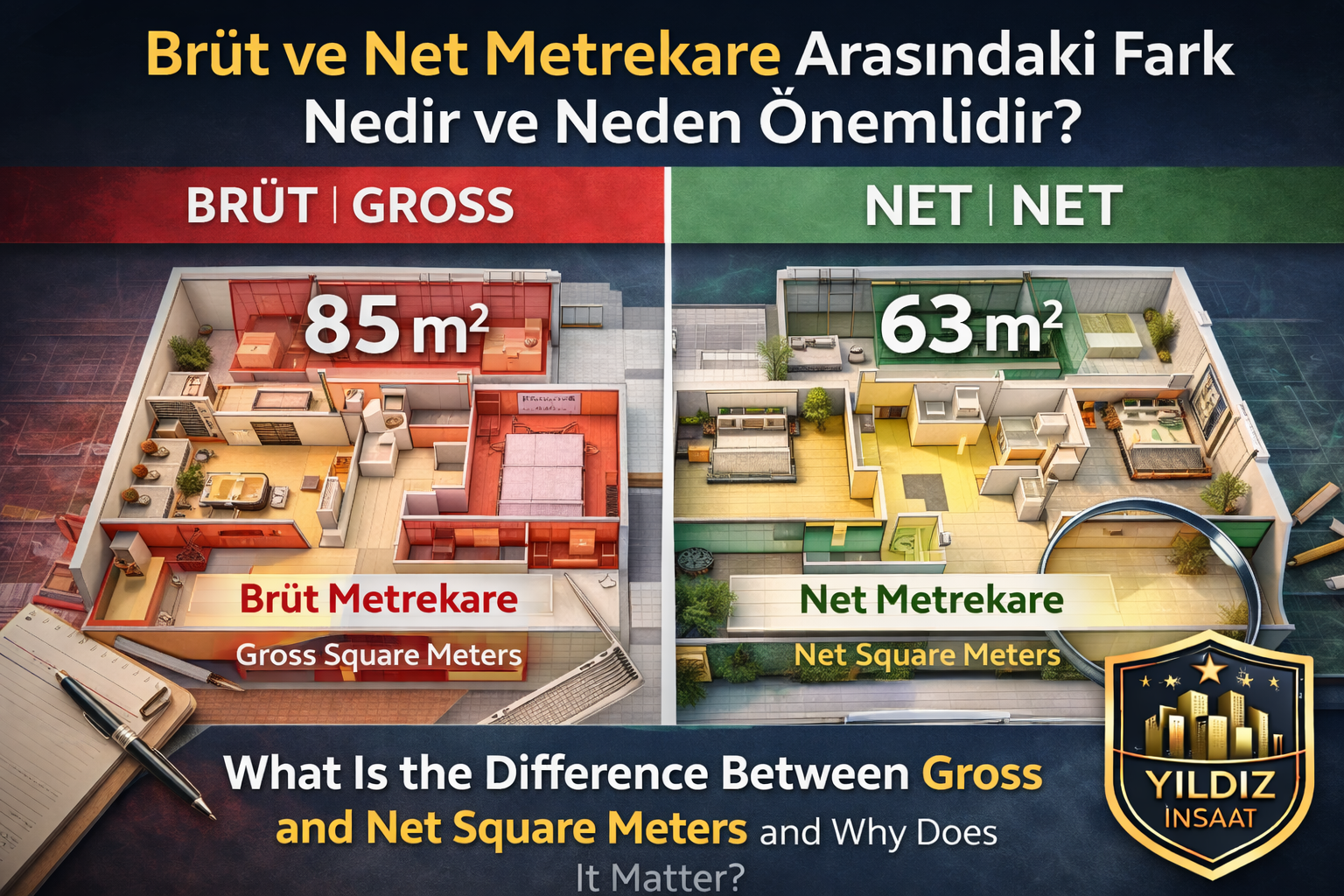
What Is the Difference Between Gross and Net Square Meters and Why Does It Matter?
2026-03-11
When evaluating an apartment, looking only at the square meter number in the listing is not enough. The difference between gross and net square meters plays an important role in understanding how much usable living space a property actually offers. This guide explains what these terms mean and why they matter before making a purchase decision.
One of the most common points of confusion when buying an apartment is the square meter figure shown in the listing. In many cases, that number creates the first impression of how large the property is. However, not every square meter figure means the same thing. Some listings emphasize gross area, while in practical terms the net usable area may matter much more. For that reason, it is not enough to ask only how many square meters a home has. The more useful question is how much of that space can actually be used in daily life.
What does gross square meter usually mean? In general, gross area refers to the total size of the property in a broader sense. This figure may include elements such as wall thickness, portions of shared areas, or sections that do not function as direct living space. Because of that, gross square meters can give a broad impression of size on paper, but they do not always show how much space the buyer will truly use every day. This is where misunderstanding often begins. A larger number can create the feeling of a larger home even when the real interior experience is more limited.
Why is net square meter often more important? Net area usually gives a clearer picture of the space that can actually be lived in and used. It helps buyers understand how practical the living room, bedrooms, kitchen, bathroom, and everyday circulation areas really are. A property may appear large in gross terms but still offer less usable space than expected. For buyers who care about comfort, furniture placement, room efficiency, and daily practicality, net square meters can therefore be much more meaningful.
Why do these two measurements confuse buyers so easily? Because many people see a larger square meter number and assume it directly represents real living area. In reality, two apartments that seem similar in overall size can feel very different once usable space is considered. One may offer a more practical layout and larger functional rooms, while the other may lose value through thicker walls, longer corridors, or a less efficient plan. That is why it is important not just to read the number, but to understand what the number is actually describing.
Why does a larger-looking apartment not always feel larger in real life? Because daily comfort depends on more than total size. Layout efficiency, room shape, hallway length, kitchen usability, storage possibilities, and furniture flow all influence how spacious a home really feels. A larger apartment on paper may feel smaller if the plan is weak. On the other hand, a home with fewer square meters may feel more open and more comfortable if the layout is well designed. Good evaluation requires looking at both the number and the quality of the space behind it.
Why does this difference matter so much during the buying process? Because buyers are not only paying for a property; they are also paying for living space. If the difference between gross and net area is not understood properly, the buyer may end up with less usable space than expected. That can reduce long-term satisfaction after the purchase. For families, remote workers, or anyone who needs storage and practical room function, even a modest difference in usable area can affect daily life in a meaningful way. Square meter information should therefore be treated as a core decision factor, not just a marketing detail.
Why should both gross and net area be considered in price evaluation? Many buyers try to compare prices quickly by dividing the asking price by the square meter figure. But that comparison becomes much less useful if the type of area is not clear. A calculation based only on gross size may make a property appear more attractive than it really is. A larger gross figure can give the impression of better value, even when the net living space is not especially strong. A more reliable comparison should look at both the overall stated size and the true usable space.
Why should buyers be careful when reading project brochures and listings? Because larger numbers often look more impressive in marketing materials. That does not automatically mean anything misleading is happening, but it does mean buyers need to read carefully. When a square meter figure appears in a listing, the right question is whether that number reflects the actual living area or a broader total figure. Buyers should pay attention not only to the size of the number, but also to what stands behind it. Clear understanding helps prevent unrealistic expectations.
Why does an in-person visit make this easier to understand? Because a property may seem spacious on paper and still feel less practical during a real visit. When walking through the apartment, it becomes much easier to judge whether the living room works well, whether the bedrooms are large enough, whether the kitchen feels functional, whether hallways take up too much space, and whether storage is sufficient. The best way to understand the difference between gross and net value is to combine technical information with a realistic observation of how the apartment would work in daily life.
For which buyers is net usable space especially important? Net area can matter even more for families with children, people working from home, households needing extra storage, or buyers planning to stay in the property for many years. In these cases, daily function matters more than a strong number on paper. It also matters for investors, because tenants usually respond more positively to homes that are practical and comfortable to use. A property that is easy to live in often performs better than one that only sounds large in a listing.
What is one of the most common mistakes buyers make? A very common mistake is comparing square meter figures without asking what type of measurement is being used. Buyers often assume that the bigger number automatically means the better home. In reality, a higher figure does not always mean better daily usability. A more careful approach is to understand whether the number is gross or net, review the layout, and consider how the apartment would function in real life. Square meter information is helpful only when it is interpreted correctly.
How can buyers tell whether a property really suits their needs? The answer depends not only on size, but also on lifestyle. How many people will live there? Which rooms will be used most often? Is storage important? Will anyone work from home? Is a child’s room or flexible extra space needed? In many cases, a smaller but better-planned apartment can be a stronger choice than a larger but less efficient one. Understanding gross and net area is therefore not just a technical detail. It is part of making a smarter and more realistic housing decision.
Conclusion The difference between gross and net square meters matters because it shapes how a property should really be understood. Gross area offers a broader total figure, while net area gives a clearer sense of what can actually be used in daily living. Focusing only on the larger number can easily lead to confusion. A better buying decision comes from understanding the type of measurement, reviewing the layout, visiting the property in person, and focusing on real-life usability. The right home is not simply the one that looks larger on paper. It is the one that works better in everyday life.
Frequently Asked Questions
What does gross square meter usually mean? It generally refers to the total size of the property in a broader sense and does not always represent directly usable living space.
Why is net square meter more important for many buyers? Because it usually gives a more realistic idea of how much space can actually be used in daily life.
Does a larger gross size always mean a better apartment? No. If the layout is inefficient or the usable area is limited, the apartment may feel smaller than expected.
Which figure should be used when comparing prices? The best approach is to review both gross and net measurements together and focus on actual usable space.
What does gross square meter usually mean? In general, gross area refers to the total size of the property in a broader sense. This figure may include elements such as wall thickness, portions of shared areas, or sections that do not function as direct living space. Because of that, gross square meters can give a broad impression of size on paper, but they do not always show how much space the buyer will truly use every day. This is where misunderstanding often begins. A larger number can create the feeling of a larger home even when the real interior experience is more limited.
Why is net square meter often more important? Net area usually gives a clearer picture of the space that can actually be lived in and used. It helps buyers understand how practical the living room, bedrooms, kitchen, bathroom, and everyday circulation areas really are. A property may appear large in gross terms but still offer less usable space than expected. For buyers who care about comfort, furniture placement, room efficiency, and daily practicality, net square meters can therefore be much more meaningful.
Why do these two measurements confuse buyers so easily? Because many people see a larger square meter number and assume it directly represents real living area. In reality, two apartments that seem similar in overall size can feel very different once usable space is considered. One may offer a more practical layout and larger functional rooms, while the other may lose value through thicker walls, longer corridors, or a less efficient plan. That is why it is important not just to read the number, but to understand what the number is actually describing.
Why does a larger-looking apartment not always feel larger in real life? Because daily comfort depends on more than total size. Layout efficiency, room shape, hallway length, kitchen usability, storage possibilities, and furniture flow all influence how spacious a home really feels. A larger apartment on paper may feel smaller if the plan is weak. On the other hand, a home with fewer square meters may feel more open and more comfortable if the layout is well designed. Good evaluation requires looking at both the number and the quality of the space behind it.
Why does this difference matter so much during the buying process? Because buyers are not only paying for a property; they are also paying for living space. If the difference between gross and net area is not understood properly, the buyer may end up with less usable space than expected. That can reduce long-term satisfaction after the purchase. For families, remote workers, or anyone who needs storage and practical room function, even a modest difference in usable area can affect daily life in a meaningful way. Square meter information should therefore be treated as a core decision factor, not just a marketing detail.
Why should both gross and net area be considered in price evaluation? Many buyers try to compare prices quickly by dividing the asking price by the square meter figure. But that comparison becomes much less useful if the type of area is not clear. A calculation based only on gross size may make a property appear more attractive than it really is. A larger gross figure can give the impression of better value, even when the net living space is not especially strong. A more reliable comparison should look at both the overall stated size and the true usable space.
Why should buyers be careful when reading project brochures and listings? Because larger numbers often look more impressive in marketing materials. That does not automatically mean anything misleading is happening, but it does mean buyers need to read carefully. When a square meter figure appears in a listing, the right question is whether that number reflects the actual living area or a broader total figure. Buyers should pay attention not only to the size of the number, but also to what stands behind it. Clear understanding helps prevent unrealistic expectations.
Why does an in-person visit make this easier to understand? Because a property may seem spacious on paper and still feel less practical during a real visit. When walking through the apartment, it becomes much easier to judge whether the living room works well, whether the bedrooms are large enough, whether the kitchen feels functional, whether hallways take up too much space, and whether storage is sufficient. The best way to understand the difference between gross and net value is to combine technical information with a realistic observation of how the apartment would work in daily life.
For which buyers is net usable space especially important? Net area can matter even more for families with children, people working from home, households needing extra storage, or buyers planning to stay in the property for many years. In these cases, daily function matters more than a strong number on paper. It also matters for investors, because tenants usually respond more positively to homes that are practical and comfortable to use. A property that is easy to live in often performs better than one that only sounds large in a listing.
What is one of the most common mistakes buyers make? A very common mistake is comparing square meter figures without asking what type of measurement is being used. Buyers often assume that the bigger number automatically means the better home. In reality, a higher figure does not always mean better daily usability. A more careful approach is to understand whether the number is gross or net, review the layout, and consider how the apartment would function in real life. Square meter information is helpful only when it is interpreted correctly.
How can buyers tell whether a property really suits their needs? The answer depends not only on size, but also on lifestyle. How many people will live there? Which rooms will be used most often? Is storage important? Will anyone work from home? Is a child’s room or flexible extra space needed? In many cases, a smaller but better-planned apartment can be a stronger choice than a larger but less efficient one. Understanding gross and net area is therefore not just a technical detail. It is part of making a smarter and more realistic housing decision.
Conclusion The difference between gross and net square meters matters because it shapes how a property should really be understood. Gross area offers a broader total figure, while net area gives a clearer sense of what can actually be used in daily living. Focusing only on the larger number can easily lead to confusion. A better buying decision comes from understanding the type of measurement, reviewing the layout, visiting the property in person, and focusing on real-life usability. The right home is not simply the one that looks larger on paper. It is the one that works better in everyday life.
Frequently Asked Questions
What does gross square meter usually mean? It generally refers to the total size of the property in a broader sense and does not always represent directly usable living space.
Why is net square meter more important for many buyers? Because it usually gives a more realistic idea of how much space can actually be used in daily life.
Does a larger gross size always mean a better apartment? No. If the layout is inefficient or the usable area is limited, the apartment may feel smaller than expected.
Which figure should be used when comparing prices? The best approach is to review both gross and net measurements together and focus on actual usable space.